inquiry@octalsoft.com


Clinical research has entered an era of unprecedented complexity.
Modern clinical trials involve global research sites, decentralized trial models, increasing regulatory expectations, diverse patient populations, and enormous volumes of clinical data. While digital transformation has improved many aspects of trial execution, clinical teams still face challenges caused by fragmented systems, manual processes, and delayed access to actionable insights.
Traditional automation has helped organizations digitize workflows, but the next evolution of clinical technology goes beyond automation.
This evolution is agentic AI.
Agentic AI introduces intelligent systems that can understand objectives, analyze information, make recommendations, and perform tasks within defined boundaries. Instead of simply responding to requests, AI agents can actively support clinical teams by monitoring trial activities, identifying potential issues, and helping optimize operations.
For sponsors, CROs, and research organizations, agentic AI represents a shift from managing trials through disconnected tools toward intelligent, data-driven clinical operations.
What Is Agentic AI in Clinical Research?
Agentic AI refers to AI systems designed to act as intelligent agents capable of completing multi-step tasks, adapting to changing information, and assisting with decision-making.
In clinical research, agentic AI can function as a digital operational assistant that works across different stages of the trial lifecycle.
For example, an AI agent could monitor enrollment trends, analyze site performance, identify potential delays, flag data inconsistencies, and recommend corrective actions.
Unlike conventional AI applications that primarily generate insights, agentic AI connects insights with actions.
This capability can help clinical teams:
- Detect operational risks earlier
- Reduce repetitive administrative work
- Improve trial visibility
- Accelerate decision-making
- Strengthen quality management
As clinical trials become more complex, intelligent AI-driven support will become increasingly important for maintaining efficiency and compliance
Why are Clinical Trial Operations Leaders choosing Agentic AI
Smarter Trial Planning and Study Design
Successful clinical trials depend heavily on early decisions around protocol design, feasibility, site selection, and patient recruitment.
Agentic AI can analyze historical trial information, operational patterns, and available clinical data to provide recommendations before a study begins.
AI-powered systems can help research teams evaluate:
- Site performance potential
- Recruitment feasibility
- Operational timelines
- Patient population availability
- Trial execution risks
By improving early-stage planning, agentic AI can help reduce delays and create more predictable trial outcomes.
AI-Powered Patient Recruitment and Engagement
Patient recruitment remains one of the biggest challenges in clinical research. Delayed enrollment can significantly increase trial timelines and operational costs.
Agentic AI can support more efficient recruitment by identifying patterns, analyzing eligibility information, and assisting teams in developing patient engagement strategies.
AI agents can help research organizations:
- Identify suitable patient populations
- Support screening workflows
- Improve communication strategies
- Monitor recruitment progress
- Predict enrollment challenges
This enables a more patient-centric approach while helping clinical teams improve recruitment efficiency.
Intelligent Clinical Data Management
Clinical trials generate data from multiple sources, including EDC systems, laboratory platforms, wearable devices, electronic health records, and patient-reported outcomes.
Managing this data traditionally requires significant manual review.
Agentic AI can help transform clinical data management by continuously monitoring information and identifying issues in real time.
AI-driven systems can support:
- Detection of missing or inconsistent data
- Prioritization of data queries
- Identification of unusual patterns
- Faster data review cycles
- Improved data quality
By reducing repetitive data management tasks, AI allows clinical professionals to focus on higher-value activities.
Proactive Risk Management and Quality Oversight
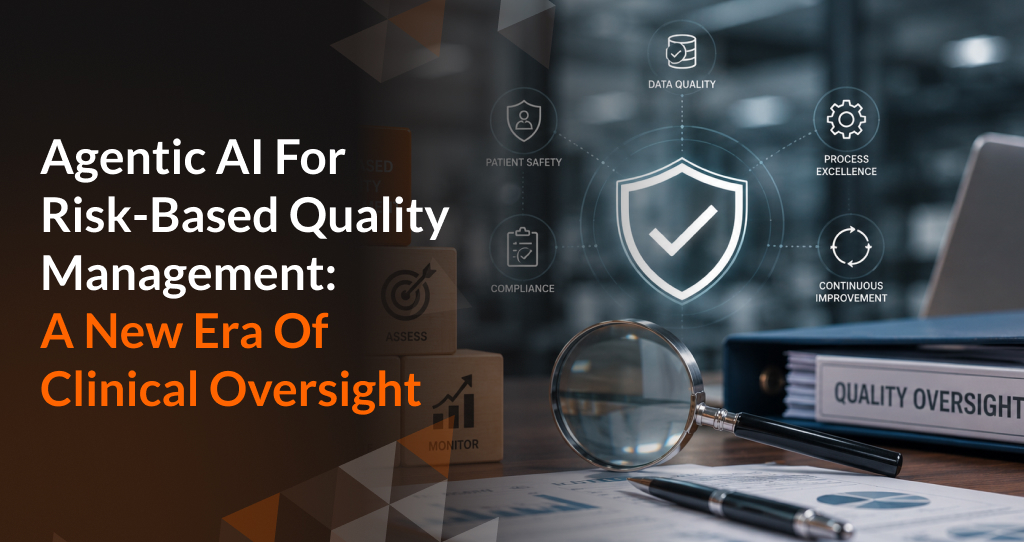
Risk-Based Data Monitoring (RBDM) emerged in the early 2000s in response to the increasing complexity of clinical trials, advancements in technology, and evolving regulations. As RBDM evolved, its focus expanded from data monitoring to overall trial quality, leading to the development of Risk-Based Quality Management (RBQM), advancing risk management to new heights. Here’s how Octalsoft Incorporates RBDM & RBQM in Its Solutions
Risk-based quality management (RBQM) has become an important approach in modern clinical trials.
Agentic AI can strengthen RBQM by continuously analyzing trial signals and highlighting areas that require attention.
AI agents can monitor:
- Site performance indicators
- Protocol deviations
- Enrollment patterns
- Data quality metrics
- Operational bottlenecks
Instead of responding after problems occur, clinical teams can use AI-driven insights to proactively manage risks.
This creates a more adaptive approach to clinical trial oversight.
The Role of eClinical Platforms in an Agentic AI Future
Agentic AI will deliver the greatest value when integrated into connected clinical technology ecosystems.
Modern clinical trials rely on multiple systems, including:
- Electronic Data Capture (EDC)
- Clinical Trial Management Systems (CTMS)
- Interactive Response Technology (IRT/IWRS)
- Electronic Trial Master File (eTMF)
- ePRO/eCOA solutions
- Quality Management Systems (QMS)
- Clinical analytics platforms
When these systems operate separately, teams often experience fragmented data, manual reconciliation, and limited visibility.
A unified eClinical platform creates the foundation for intelligent clinical operations by connecting data, workflows, and decision-making.
Octalsoft’s integrated eClinical ecosystem helps sponsors, CROs, and research organizations streamline clinical trial management through connected solutions across clinical data management, trial operations, quality, and analytics.
With solutions including EDC, CTMS, IWRS, eTMF, ePRO/eCOA, QMS, and analytics capabilities, Octalsoft enables organizations to create a stronger digital foundation for AI-driven clinical research.
By combining connected technology with emerging AI capabilities, clinical teams can move toward faster, smarter, and more efficient trial execution.
Benefits of Agentic AI in Clinical Research
Improved Operational Efficiency
Agentic AI can automate repetitive workflows and help teams spend more time on strategic clinical decisions.
Faster Decision-Making
By continuously analyzing trial information, AI agents can provide timely insights that support faster operational actions.
Enhanced Data Quality
AI-driven monitoring can help identify inconsistencies earlier and improve the reliability of clinical trial data.
Better Compliance Readiness
AI-assisted documentation, workflow tracking, and quality monitoring can support stronger regulatory processes.
More Patient-Centric Trials
Intelligent systems can improve patient engagement by enabling more personalized communication and support.
Challenges of Implementing Agentic AI in Clinical Trials
While agentic AI offers significant opportunities, organizations must carefully consider implementation challenges.
Clinical data requires strong privacy and security controls. AI systems must operate within regulatory expectations around transparency, validation, and accountability.
Human oversight will also remain essential. Agentic AI is designed to augment clinical expertise, not replace researchers, physicians, and trial professionals.
Successful adoption will depend on integrating AI into reliable eClinical ecosystems rather than deploying isolated tools.
The Future of Agentic AI in Clinical Research
The future of clinical trials will be shaped by collaboration between human expertise and intelligent technology.
AI agents may soon support clinical teams throughout the trial lifecycle — from study design and patient recruitment to data review, quality management, and operational optimization.
The goal is not fully autonomous clinical research, but smarter clinical operations where technology helps teams make better decisions faster.
As clinical research continues evolving, organizations with connected eClinical platforms will be better positioned to adopt AI-driven innovation while maintaining quality, compliance, and patient focus.
Agentic AI represents the next step in the digital transformation of clinical trials — moving from automated workflows to intelligent clinical ecosystems.
The Future of Agentic AI with Octalsoft
The next phase of clinical research will not be defined only by automation, but by intelligent collaboration between humans and AI.
Future clinical teams may rely on AI agents that can:
- Monitor trial performance continuously
- Recommend operational improvements
- Identify potential compliance risks
- Support faster data review
- Improve patient engagement strategies
- Provide real-time trial intelligence
For organizations adopting modern eClinical ecosystems, agentic AI represents an opportunity to improve efficiency while maintaining the human expertise required for successful clinical research.
Octalsoft’s vision for connected clinical technology aligns with this future — where unified platforms, intelligent workflows, and AI-driven insights work together to make clinical trials faster, smarter, and more efficient. Octalsoft provides integrated eClinical solutions that connect clinical trial workflows, data management, quality processes, and analytics, creating a foundation for intelligent clinical operations.