inquiry@octalsoft.com



Clinical trials require a delicate balance between operational efficiency, participant safety, data integrity, and regulatory compliance. As studies become more complex and generate increasing volumes of clinical and operational data, identifying the issues that matter most has become a central challenge for sponsors and contract research organizations (CROs).
Traditional monitoring approaches remain important, but reviewing every data point or site activity with the same intensity may not be the most effective use of available resources. Risk-based quality management (RBQM) addresses this challenge by directing oversight toward critical processes, important data, and risks that could affect participant safety or the reliability of trial results.
Artificial intelligence (AI) and machine learning (ML) introduce another opportunity: helping teams recognize patterns in clinical and operational data, identify potential risk signals, and prioritize issues for investigation.
As the clinical data management community continues to explore technology-driven approaches around SCDM 2026, AI-driven RBQM is an important area of discussion.
At Octalsoft, we see connected clinical data and intelligent analysis as complementary capabilities that can support a more proactive approach to clinical trial oversight.
What Is Risk-Based Quality Management (RBQM)?
Risk-based quality management is an approach to clinical trial oversight that identifies and manages risks according to their potential impact on participant safety and the reliability of trial results.
Rather than treating every process and data point as equally critical, RBQM encourages organizations to identify what matters most, establish suitable controls, and direct resources toward areas requiring greater attention.
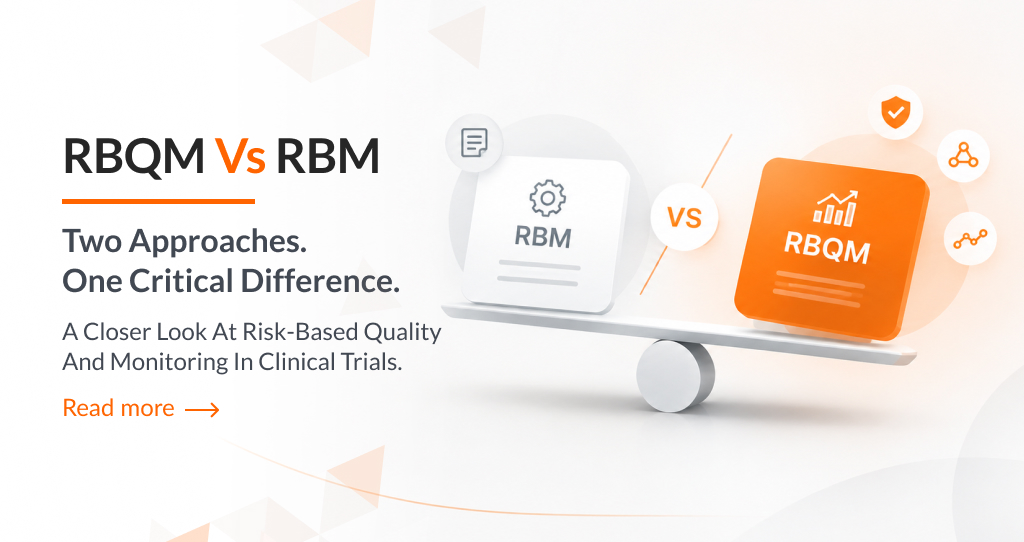
This approach is closely related to risk-based monitoring (RBM), which focuses on planning and conducting monitoring activities according to identified risks.
The US Food and Drug Administration's guidance on risk-based monitoring describes approaches sponsors can use to plan monitoring, evaluate results, and address issues identified during clinical investigations. It also discusses the potential value of real-time clinical data quality metrics for identifying sites that may require more intensive monitoring. <Cite refs={["turn353860search2","turn353860search23"]}/>
RBQM can involve several activities:
- Identifying critical-to-quality factors and processes.
- Assessing risks to participant safety and data reliability.
- Defining risk indicators and appropriate thresholds.
- Monitoring relevant clinical and operational information.
- Investigating issues and implementing corrective or preventive actions.
- Reassessing risks as the study progresses.
AI/ML can potentially strengthen parts of this process by helping teams analyze relevant information and identify patterns that deserve further investigation.
Why Traditional Risk Detection Needs to Evolve
Clinical trials generate information across sites, investigators, EDC systems, CTMS platforms, monitoring activities, and quality processes. Identifying meaningful risk signals across these sources can be challenging when information is fragmented or reviewed retrospectively.
Several recurring challenges can limit the effectiveness of risk detection.
Fragmented data: Information spread across different systems can make it harder to identify relationships between clinical data quality and operational performance.
Delayed visibility: Some issues become apparent only after recurring discrepancies, missed milestones, or other trends have developed.
High volumes of alerts: Excessive notifications can make it difficult for teams to distinguish meaningful risks from routine exceptions.
Resource constraints: Monitoring and quality teams must decide where to focus limited time and attention.
Changing risk profiles: A site's performance or a study's operational conditions can change over time, requiring risk assessments to be reviewed and updated.
AI-driven RBQM does not eliminate these challenges automatically. However, when supported by suitable data and well-designed workflows, it can help teams examine patterns more efficiently and focus investigation on potential issues that matter.
Five Ways AI Can Strengthen RBQM in Clinical Trials
1. Identifying Emerging Risk Signals Earlier
Conventional risk indicators and predefined thresholds remain essential for monitoring critical trial processes. AI/ML can potentially complement these approaches by examining relationships and patterns that are less obvious in individual data points.
For example, recurring data discrepancies across several visits or an unusual pattern in site-level metrics may warrant further investigation.
An AI-assisted system could flag the pattern for review, allowing the study team to assess the underlying records and determine whether the finding indicates a meaningful risk.
The distinction is important: a model identifies a potential signal, not a confirmed quality issue. Clinical context and professional assessment remain necessary.
2. Making Risk-Based Monitoring More Targeted
Risk-based monitoring seeks to direct oversight toward critical data and processes rather than applying the same level of monitoring everywhere.
AI/ML may help analyze relevant indicators to support the prioritization of sites, records, and activities for review.
Potential inputs could include missing-data rates, query trends, protocol deviations, monitoring findings, and site performance metrics, where appropriate and available.
By highlighting patterns that meet defined criteria or warrant investigation, intelligent analysis may help teams decide where additional attention is needed.
These insights should complement an established monitoring plan, documented risk assessments, and applicable study procedures. AI-generated priorities should not replace sponsor accountability or required monitoring activities.
3. Connecting Clinical and Operational Risk Indicators
A clinical trial's risk profile is rarely confined to a single system.
EDC may contain information about clinical data completeness and discrepancies. CTMS may provide relevant operational information about site activities, monitoring, and milestones. QMS may contain records associated with quality events and corrective or preventive actions.
When appropriate information is connected, teams can investigate potential relationships between clinical and operational issues.
For example, repeated unresolved queries combined with delayed site follow-up might justify closer review. An integrated view can help investigators understand the context instead of evaluating each indicator in isolation.
AI/ML can potentially assist with identifying such patterns, provided the relevant data is available, appropriately integrated, and suitable for the intended analysis.
4. Supporting Continuous Risk Assessment
Risk assessments should reflect the evolving conditions of a clinical trial.
A site that initially performs well may encounter staffing or enrollment challenges. A data collection process may generate unexpected inconsistencies. A previously unrecognized risk may emerge as more information becomes available.
AI-assisted analytics can potentially help teams identify changes in relevant indicators and determine when a risk assessment deserves review.
This supports a more adaptive approach to oversight, in which teams can investigate emerging issues rather than relying exclusively on initial assumptions.
However, continuous monitoring requires carefully defined indicators, appropriate thresholds, reliable data, and a clear escalation process. Changes in a metric should be interpreted in context, not automatically treated as evidence of increased risk.
5. Improving the Prioritization of Quality Actions
Identifying risk is only one part of RBQM. Teams must also investigate issues, document decisions, assign responsibilities, and determine appropriate corrective or preventive actions.
AI-assisted tools may help organize relevant information, summarize trends, and highlight recurring issues that deserve attention.
When connected with established quality management workflows, these capabilities may support more efficient review and follow-up.
Final decisions about investigation findings, corrective actions, and quality dispositions must remain governed by appropriate procedures and qualified personnel.
The objective is to help teams move from identifying potential problems to managing them in a structured, traceable manner.
How Connected eClinical Solutions Support AI-Driven RBQM
AI-driven RBQM depends on more than analytical models. It also requires a reliable technology environment that makes relevant information available to the people responsible for oversight.
Octalsoft's integrated eClinical portfolio includes solutions supporting clinical data capture, trial operations, documentation, and quality management.
These include:
- EDC: Supports electronic clinical data collection, validation, and data management workflows.
- CTMS: Supports study operations, site coordination, and monitoring-related activities.
- eTMF: Supports the management of essential clinical trial documentation.
- IWRS/RTSM: Supports randomization and trial supply management workflows.
- eCOA/ePRO: Supports digital clinical outcome assessment and patient-reported data collection.
- rSDV: Supports remote source data verification workflows.
- QMS: Supports quality processes and associated records.
Each system contributes a different perspective on clinical trial execution.
When relevant information can be accessed across connected workflows, organizations have a stronger foundation for investigating potential risks and coordinating appropriate responses.
Octalsoft's approach to AI/ML-driven eClinical technology focuses on the opportunity to complement this foundation with intelligent analysis and workflow support.
Specific predictive functions depend on the implementation, data availability, and intended use. Organizations should evaluate individual capabilities against their operational and regulatory requirements.
Responsible AI: Accuracy, Explainability, and Human Oversight
In clinical research, a false alert can waste valuable resources, while a missed signal can leave an important issue undiscovered. AI-driven RBQM must therefore be implemented with appropriate safeguards.
Several considerations are essential.
Data quality and relevance: Models need suitable, reliable data that reflects the intended clinical and operational context.
Validation: Performance should be evaluated for the intended use, including the potential consequences of false positives and false negatives.
Explainability: Users need sufficient information to understand why an issue was flagged and what evidence supports further investigation.
Human oversight: Qualified professionals must assess findings, determine their significance, and decide on appropriate actions.
Traceability: Risk assessments, review decisions, and relevant actions should be documented according to established procedures.
Ongoing monitoring: Model performance and suitability should be reassessed as study conditions and data patterns evolve.
These principles are consistent with the broader risk-based approach to clinical trial oversight promoted by regulators. FDA guidance emphasizes the importance of focusing monitoring on issues that could affect participant protection and clinical trial data quality. <Cite refs={["turn353860search2","turn353860search5"]}/>
AI should strengthen a well-designed quality framework—not become a substitute for one.
SCDM 2026: Moving From Risk Detection to Predictive Insights
The clinical data management community is increasingly exploring how connected data, advanced analytics, and AI can support more proactive clinical research.
For sponsors and CROs considering AI-driven RBQM, the priority should be identifying practical use cases and evaluating them against measurable objectives.
Questions worth asking include:
- Can the approach identify meaningful risk signals earlier than existing processes?
- Does it reduce unnecessary alerts while preserving sensitivity to important issues?
- Can teams understand and investigate the reasons behind a flagged risk?
- Does it integrate with existing monitoring and quality workflows?
- Are model performance, data governance, and human oversight adequately addressed?
The answers will vary by study design, therapeutic area, data availability, and organizational maturity.
A successful implementation begins with clearly defined critical-to-quality factors, a structured risk assessment, reliable data, and an agreed process for reviewing and acting on findings.
The goal is not to automate every risk decision. It is to help clinical research teams make more informed, timely, and consistent decisions about where oversight is needed.
Conclusion: Smarter Risk Management Starts With Connected Data
AI-driven RBQM represents an opportunity to strengthen how clinical trial risks are identified, assessed, and managed.
AI/ML can potentially help detect unusual patterns, prioritize monitoring activities, connect relevant risk indicators, and support quality follow-up. Its value depends on reliable data, appropriate validation, integration with established processes, and human oversight.
For Octalsoft, the opportunity lies in combining connected eClinical capabilities with responsible intelligence to support more coordinated clinical trial operations.
As clinical research evolves, organizations that approach AI with clear objectives and strong governance will be better positioned to evaluate where it can deliver meaningful value.
Explore how connected eClinical solutions can support your clinical data management, risk oversight, and quality workflows.
Request a demo: https://www.octalsoft.com/request-a-demo/
Octalsoft. One Platform. Complete Control. Intelligent Solutions.